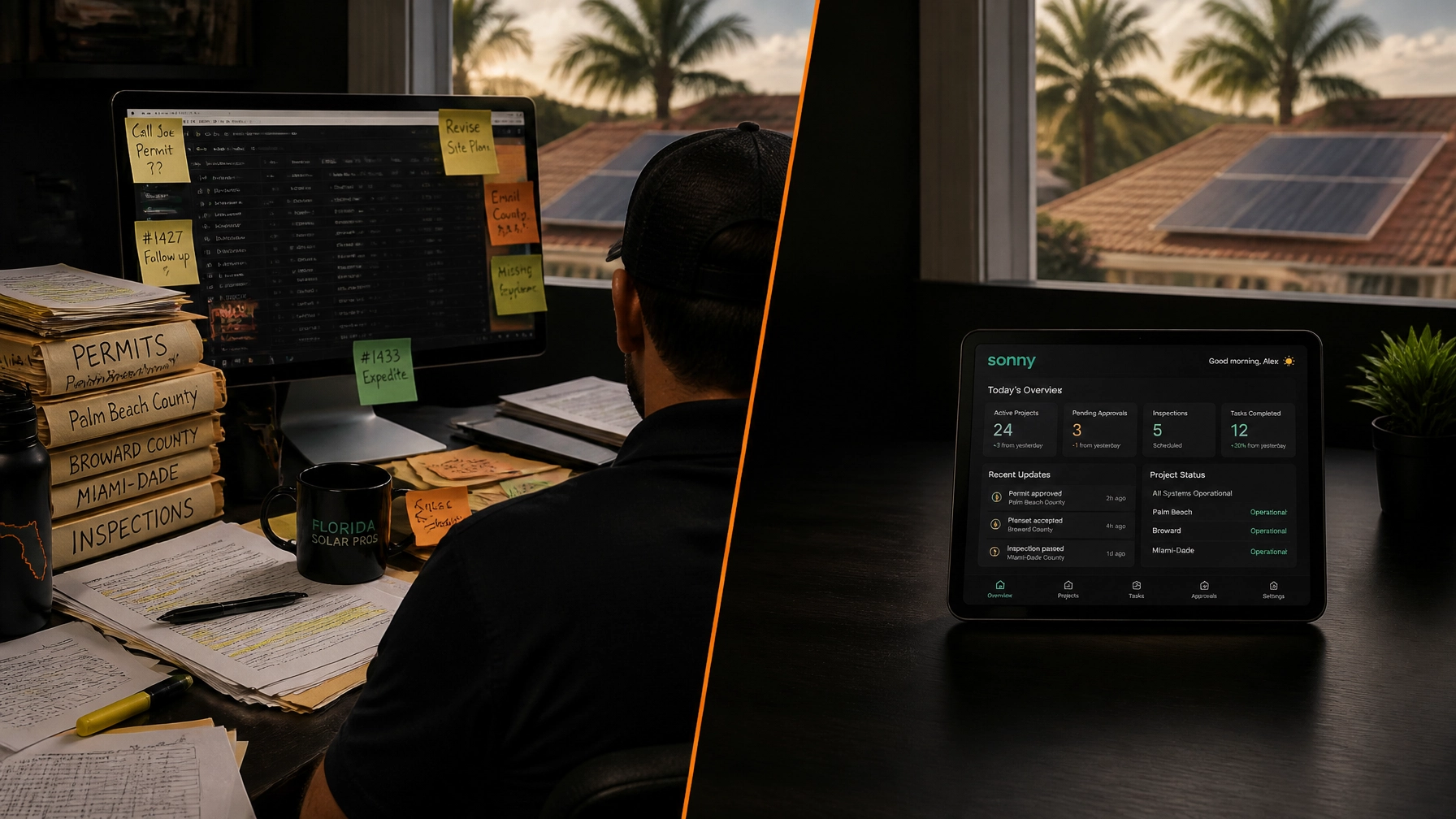
If you’re running a residential solar EPC in Florida doing between 10 and 30 installs a month, you’ve likely hit the "Ops Ceiling."
It usually happens right around the $2 million revenue mark. You’ve got the sales engine humming. The crews are solid. But the back office: the machine that’s supposed to move a signed contract through engineering, permitting, and interconnection: is starting to smoke.
Your first instinct is usually to hire. You need more "hands on deck" to chase homeowners for utility bills, call AHJs about permit status, and make sure FPL or Duke actually received the interconnection application.
But here is the hard truth: In 2026, you cannot hire your way out of an operational bottleneck.
Every time you add a person to a manual process, you aren't just adding a salary; you're adding complexity, room for error, and a massive annual overhead that eats your margins before the first panel even hits the roof.
Let’s look at the actual math of a manual solar operations team in Florida today.
The $205,000 Anchor: The Real Cost of a 4-Person Ops Team
When most owners look at their payroll, they see base salaries. When an operator looks at payroll, they see the "fully loaded" cost. In Florida, for a team capable of handling 20+ jobs a month manually, your roster usually looks like this:
- Senior Ops Manager: $75,000/yr (The "firefighter" who knows every AHJ and manages the team).
- Project Coordinator: $50,000/yr (Chases documents and keeps the customer updated).
- Permit/Document Admin: $42,000/yr (Handles the tedious uploads to 50 different portals).
- Follow-up Coordinator: $38,000/yr (The person who calls the utility and the homeowner 10 times a day).
Total Base Salaries: $205,000/year.
But that’s not the whole story. Once you account for employer taxes (Social Security, Medicare, FUTA/SUTA), health insurance, PTO, and the software seats they need, that $205k is actually closer to $260,000 in cash leaving your business.

The "Invisible" Costs of Manual Labor
The $205,000 is what you see on the Profit & Loss statement. What you don't see are the costs associated with human-driven processes.
1. The Error Tax
When a manual admin submits a permit to the City of Orlando or Hillsborough County, they might forget a site plan signature or use an outdated form. In Florida, a "Minor Correction" can set a permit back 14 days. If your 4-person team has a 20% rejection rate (common for manual ops), you are losing weeks of cash flow on every fifth job.
2. The Turnover Toll
Solar operations is a high-burnout job. Chasing homeowners and arguing with AHJs is draining. When your Permit Admin quits, you lose 30 days of momentum while you hire and another 60 days while they "learn" your specific way of doing things. That’s a $15,000 mistake you’ll pay for every 18 months.
3. The "Where is my Job?" Phone Calls
Manual teams spend 40% of their day answering the phone to tell a homeowner that "we're still waiting on the city." This is defensive work. It adds zero value to the bottom line but requires a full-time salary to manage.
The Industry Shift: From Staffing to Systems
The most successful EPCs in Florida aren't the ones with the biggest offices; they are the ones with the leanest teams. They have realized that human beings are terrible at repetitive follow-ups, but computers are perfect at them.
We are seeing a fundamental shift in how solar operations are built. Instead of hiring a fourth person when volume increases, owners are implementing a solar operations system that automates the "grunt work."
Imagine an environment where:
- The homeowner is automatically texted and emailed until they upload their utility bill, with the system checking the document for legibility in real-time.
- The AHJ's requirements for every Florida jurisdiction are pulled instantly, ensuring the first permit submission is 100% compliant.
- The utility interconnection (FPL, Duke, or TECO) is tracked by an AI agent that logs in daily and alerts you only if there is a real problem.

The Math of the "New Way"
If you replace the manual "Document Chasers" and "Permit Uploaders" with a dedicated solar operations system powered by AI agents, your team structure changes drastically.
Instead of 4 people, you keep:
- 1 Junior Ops Coordinator (to handle high-level exceptions).
- 1 Office Assistant (for customer-facing "human" moments).
The system handles the other 80% of the workload.
The ROI Calculation:
- Old Cost: $205,000/yr (Payroll)
- New Cost: $89,000 (Lean Payroll) + $30,000 (Software & System Retainer) = $119,000/yr
Annual Savings: $86,000.
That is $86,000 in pure profit added back to your bottom line, every single year, without firing a single salesperson or installing a single extra panel.
Scaling Without Friction
The real benefit isn't just the $86k in savings. It's the ability to scale.
With a manual team, if you go from 15 installs a month to 30, you have to hire two more people. Your overhead grows exactly as fast as your revenue. Your stress doubles.
With an AI-powered system, the cost to go from 15 to 30 installs is negligible. The "agents" don't ask for a raise, they don't get overwhelmed, and they don't forget to follow up with the homeowner on a Friday afternoon.

Stop Managing People, Start Managing the Machine
If you are the owner and you are still the one checking if the FPL application was submitted, you don't have a business: you have a very stressful job.
The hidden cost of manual operations isn't just the payroll. It's the cost of your time. It’s the cost of the jobs that stall out and never reach PTO. It’s the cost of the referrals you lose because your communication was "messy."
The industry is shifting. The EPCs that will own the Florida market in 2027 and beyond are building their operations on a foundation of automation, not a mountain of payroll.
It’s time to decide if you want to be a staffing agency that happens to sell solar, or a high-efficiency installation machine.
Want to see what a "16-agent" operational system looks like in action?
Explore how to systemize your pipeline at gridreadyops.com.
Leave a Reply