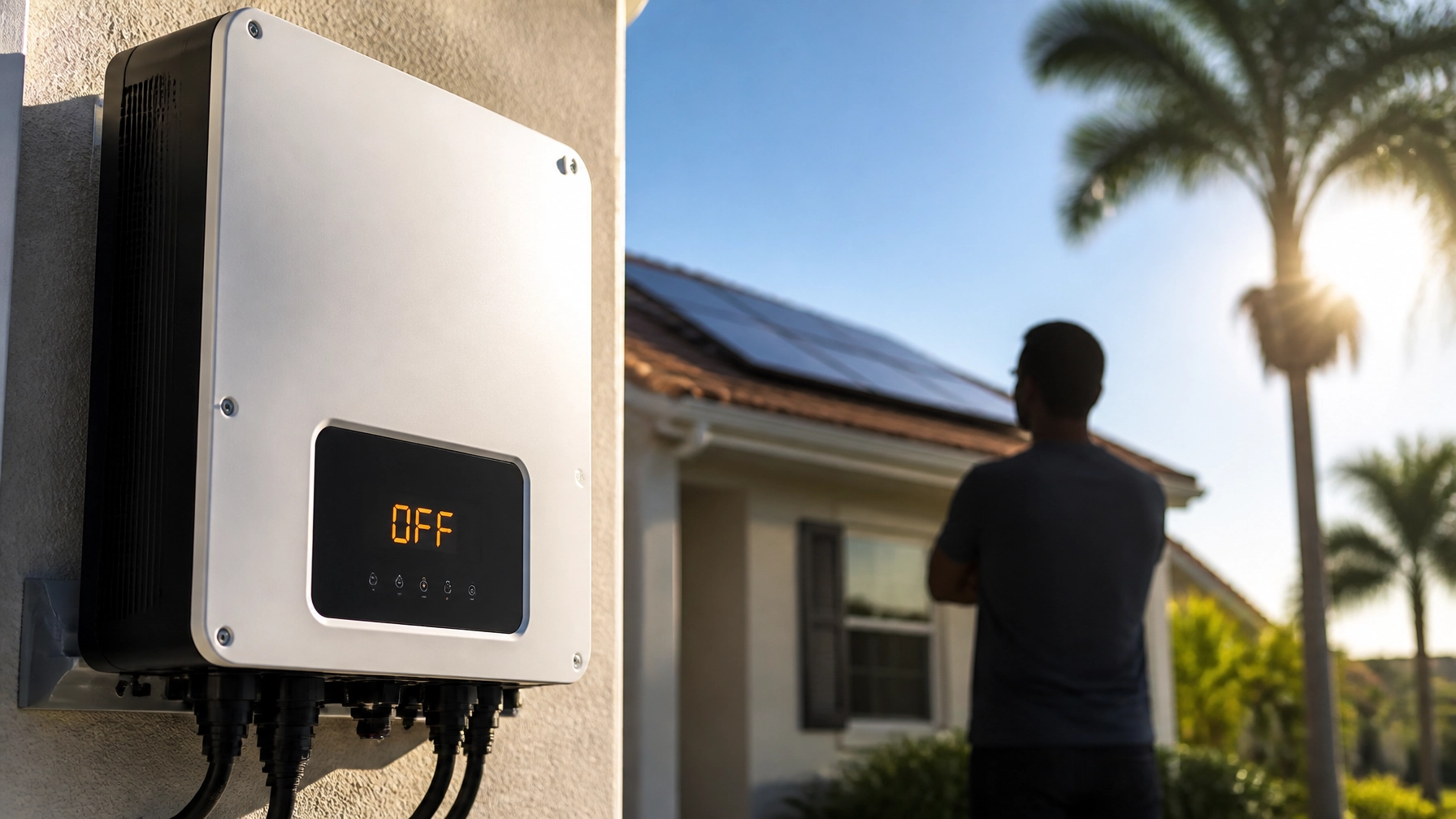
If you’re running a residential solar EPC in Florida doing anywhere from 5 to 30 installs a month, you know the feeling. The crew has finished the job. The panels look great. The homeowner is happy: for about 48 hours. Then they realize their shiny new $40,000 investment isn’t actually doing anything. It’s just expensive glass on their roof.
In the industry, we call this "Phantom Inventory." You’ve spent the cash on equipment. You’ve paid the labor. You’ve paid the sales commission. But the final milestone payment or the financing remains out of reach because the system isn't "Permission to Operate" (PTO) status.
When jobs sit between installation and PTO for 4, 6, or even 8 weeks, it isn't just a customer service headache. It’s a cash flow killer. If you have 10 jobs at $35k each sitting in PTO limbo, that’s $350,000 in revenue trapped on roofs while your bank account stays flat. If that sounds familiar, our breakdown of manual operations costs shows why so many solar teams still get stuck in the same post-install bottlenecks.
So why is this so hard in Florida? Here are the 5 most common reasons for solar PTO delay and what you can do to fix them.
1. The "Tier 2" Insurance and Fee Trap
Florida has a specific 3-tier system for net metering. Most residential systems fall into Tier 1 (up to 10kW AC). But as systems get larger: especially with the rise of EVs: more Florida homeowners are pushing into Tier 2 (>10kW to 100kW AC). That shift matters even more now, especially as Florida net metering rates are dropping and system economics get tighter.
If your team treats a Tier 2 job like a Tier 1 job, it will stall immediately. FPL, Duke, and TECO require:
- A specific application fee (usually around $400 for Tier 2).
- Proof of $1 million in general liability insurance.
If your operations person doesn't catch that the system design hit 10.1kW AC, the application will sit in a "pending" queue for weeks before a utility reviewer finally tells you it’s incomplete. By then, the homeowner is already calling you every morning.

2. Mismatched Data (The "Typo" Rejection)
Utilities like Florida Power & Light (FPL) are notoriously picky. If the name on the interconnection agreement says "Johnathan Smith" but the utility bill says "John Smith," the application is getting bounced.
The same goes for the service address. If your CRM has "123 Main St. South" and the utility has "123 Main St. S," that's a potential two-week delay. Manual data entry is the enemy here. When your staff is copying and pasting account numbers and addresses from a PDF bill into a portal 20 times a day, mistakes are inevitable. Those mistakes are the primary cause of failed first-time submissions.
3. The AHJ Inspection Lag
In Florida, the utility won't even look at your PTO request until the Authority Having Jurisdiction (AHJ): the city or county: has closed out the permit.
The bottleneck usually happens here: the inspector passes the job on Tuesday, but the AHJ's online portal doesn't update to "Finaled" until the following Monday. If your ops team waits for a physical green tag or an email, they’re losing days. Even worse, if the AHJ forgets to send the "Notification of Construction" to the utility, the job sits indefinitely.
Successful EPCs don't wait for the AHJ to move. They have a process to "force" the notification the moment the inspector leaves the driveway.

4. Improper Inverter Commissioning
The utility needs to know the system is safe for the grid. This means the inverter must be set to the correct IEEE 1547-2018 grid profile.
Too often, a crew finishes the install, flips the switch to see the lights turn on, and leaves. They forget to:
- Set the specific utility grid profile.
- Upload the commissioning report to the manufacturer portal (Enphase, SolarEdge, etc.).
- Take a photo of the "Visible, Lockable AC Disconnect" which is required for many Florida IOUs.
When the utility reviewer checks the system remotely (which many can now do via the cellular/Wi-Fi link), and they see the wrong settings, they won't grant PTO. They’ll just move on to the next application in their stack of thousands.
5. Parallel Submission Failures
The "Old School" way of doing ops is linear:
- Sell Job -> 2. Design -> 3. Permit -> 4. Install -> 5. Start Interconnection -> 6. PTO.
The "New School" way is parallel. For FPL interconnection, you can: and should: submit the "Pre-Approval" application the moment the contract is signed. If you wait until after the install to start the paperwork, you are adding at least 14 days of unnecessary wait time to your project lifecycle.
Most small EPCs do this because their ops team is too overwhelmed to manage two separate tracks of paperwork at once. They wait for the "milestone" of installation to trigger the next batch of work. This is a manual-labor mindset that is costing you thousands in interest and overhead.

The Fix: Moving from Manual to Machine
If you’re the owner of a Florida EPC, you shouldn’t be the one checking if a permit was "finaled" in the Hillsborough County portal. And you shouldn't be paying someone $50,000 a year just to play phone tag with Duke Energy.
The fix isn't "hiring a better admin." The fix is a system that runs without you.
At GridReady, we take the manual labor out of the solar operations system. We migrate Florida EPCs onto a platform that combines JobTread project management with DATAx AI agents. If you want to see what that looks like in the real world, check out this AI-powered case study.
These AI agents don't get tired, they don't miss typos, and they work 24/7. They:
- Scrub the utility bill to ensure the interconnection agreement is a 100% match.
- Monitor AHJ portals every hour for inspection pass-offs.
- Trigger the utility submission the second the permit closes.
- Track the "Time-to-PTO" and alert you if a utility reviewer is sitting on a file for more than 5 days.
By automating the "boring" parts of the job, your team can focus on what actually makes money: getting more glass on more roofs.
Stop letting your cash flow sit on the roof. It’s time to tighten your PTO timeline and get your systems turned on.
Ready to automate your operations? See how we build your custom system in 7 days at gridreadyops.com.
Leave a Reply