If you’re running a residential solar EPC in Florida, you probably know your sales numbers by heart. You know how many deals you signed this month, what your average ticket size is, and how many crews are out on roofs today.
But for most operators doing 5 to 30 installs a month, the "middle" of the business is a black box.
Once the contract is signed, the job disappears into a folder or a basic spreadsheet. You don't really know it’s stuck until a homeowner calls you three weeks later asking why they don't have panels yet. Or worse, you find out a permit was rejected ten days ago and nobody noticed.
Operating without clear metrics isn't just stressful; it’s expensive. Every day a job sits idle is a day you aren’t getting paid.
At GridReady, we’ve built and proven an operational system inside a live Florida solar EPC designed to shine a light on these exact bottlenecks. It’s not about doing more work; it’s about measuring the work so it actually gets done.
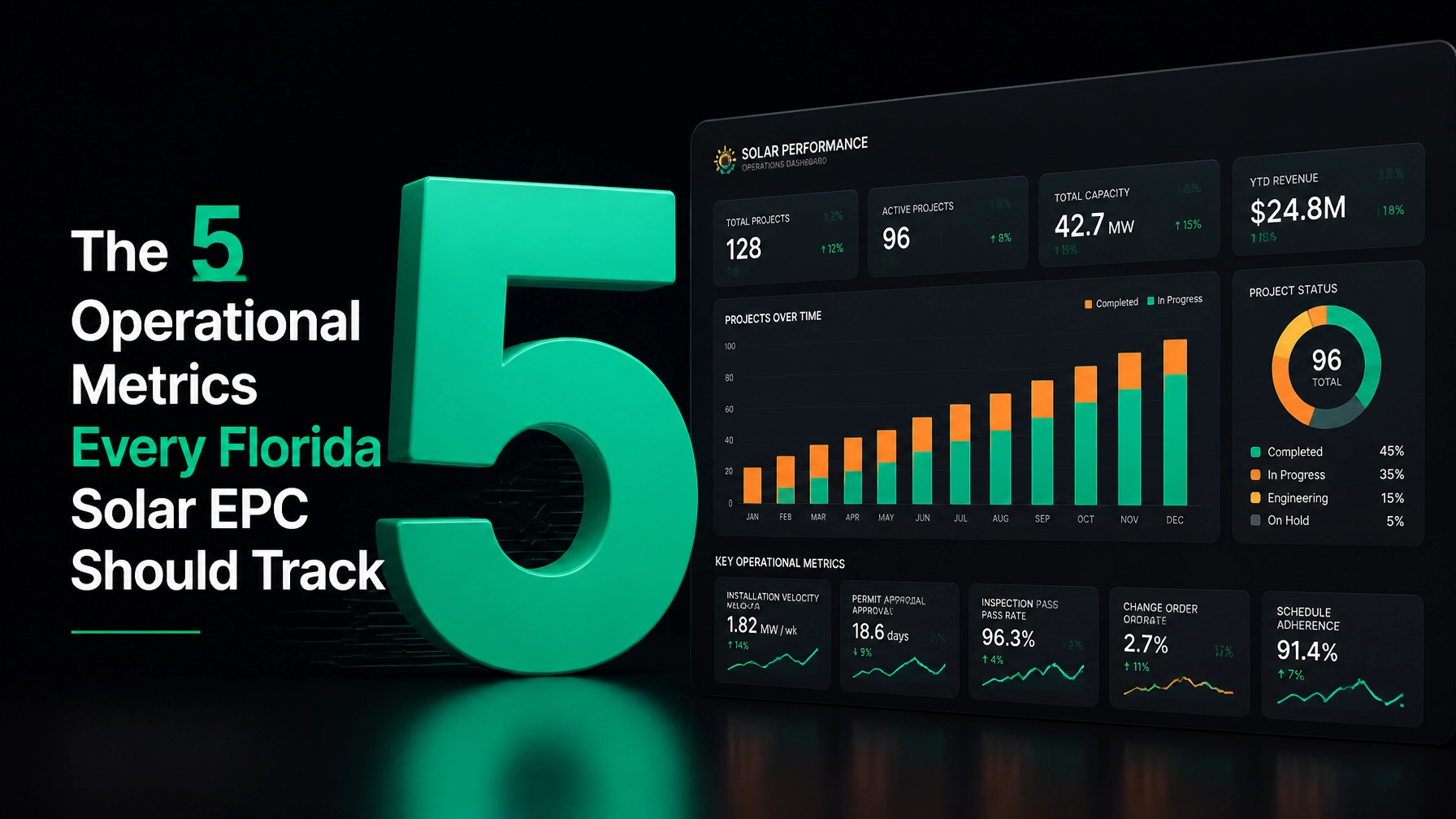
Here are the five operational metrics you should be tracking to stop the "leaky bucket" in your solar business.
1. The Intake Gap: Contract-to-Submission Lag
The clock starts the second the homeowner signs the contract. In a perfect world, that job would move to engineering and then to the permit office within 48 hours.
In reality, many Florida EPCs have an "Intake Gap" of 7 to 14 days.
This usually happens because document collection is manual. Someone has to chase the homeowner for a clear copy of their utility bill, a signed notice of commencement, or photos of the main breaker bar. If your team is busy, those emails don't get sent for three days. Then the homeowner takes four days to reply.

What to track: The average number of business days from "Signed Contract" to "First Permit Submission."
Why it matters: If you can cut this gap from 10 days down to 2, you just shaved over a week off your total project timeline without hiring a single new installer. Our system is a designed capability built to automate these document requests and follow-ups, ensuring the job is ready for submission as fast as humanly possible.
2. Permit First-Pass Yield
Florida AHJs (Authorities Having Jurisdiction) are notoriously picky. Whether you’re dealing with the City of Orlando or Miami-Dade, a single missing signature or an incorrect wire size on a drawing can result in a rejection.
When a permit is rejected, the "clock" resets. Your team has to find the error, fix the drawing, and resubmit.
What to track: The percentage of permit applications that are approved on the first submission without corrections.
Why it matters: If your First-Pass Yield is below 80%, your office staff is spending half their time fixing old mistakes instead of moving new jobs forward. This is the hidden cost of running solar operations manually. Tracking this allows you to see if the issue is with your engineering partner or your internal admin team.
3. The Momentum Gap: Install-to-Inspection Request
We see this all the time: a crew finishes an install on a Tuesday, but the inspection isn’t requested until Friday.
Why? Because the crew didn't upload the completion photos until they got back to the warehouse, or the office manager was busy with payroll and didn't see the "Job Complete" status in the CRM.
What to track: The number of hours (not days) between the panels being mounted and the inspection request being sent to the county or city.

Using solar project management software like the systems we deploy, this handoff can be almost instantaneous. The system is designed to detect when a job status changes and immediately prompt the right person to take action. While a human still performs the actual external submission to the government portal, the system ensures they are prompted to do it the moment it's possible.
4. PTO Submission Speed (The "Dead Zone")
This is perhaps the most critical metric for your cash flow. Once the final inspection passes, the job enters what we call the "Dead Zone." The panels are on the roof, the homeowner is happy, but the system is off.
Until you submit the final paperwork to the utility (FPL, Duke, TECO, etc.) for Permission to Operate (PTO), you can't officially close the job or get your final milestone payment.
What to track: Days from "Passed Final Inspection" to "PTO Application Submitted."

If this lag is more than 24 hours, you are literally leaving money on the table. We’ve seen EPCs with jobs sitting for weeks after inspection simply because the "PTO paperwork" person was out sick or forgot. This is why Florida solar EPCs are losing money after installation : the physical work is done, but the administrative "last mile" is broken.
5. Homeowner Response Time
You can have the best solar workflow automation in the world, but if the homeowner doesn't sign the interconnection agreement or clear their dog out of the yard for the inspector, the job stops.
What to track: The average time it takes a homeowner to complete a requested task.
Our system is built and proven inside a live Florida solar EPC to handle this automatically. It doesn't just send one email and hope for the best. It sends a text, follows up 24 hours later, and keeps the homeowner engaged until the task is done. Tracking this metric helps you identify "problem" customers before they tank your project averages.
How to Track Metrics Without Losing Your Mind
If you try to track these 5 metrics using a manual spreadsheet, you’ll spend 10 hours a week just updating data. That’s exactly what most owners want to avoid.
The goal isn't to become a data scientist; the goal is to have a system that tracks these numbers for you.
At GridReady, we don't just give you a "tool." We build a designed capability for your business. We migrate your operations onto a platform that combines project management with AI agents to automate the tedious parts of the job lifecycle.
The system handles the document chasing, the status tracking, and the communication prompts. It puts the metrics in front of you in real-time, so you can see exactly where a job is stuck without having to ask your staff.

If you’re ready to stop guessing and start growing, check out our pricing or book a call to see how we can build your operational machine in 5–7 business days.
Key Takeaways for Florida EPCs:
- The Intake Gap is usually where you lose your first 10 days of project time.
- Permit First-Pass Yield tells you if your engineering is actually up to Florida standards.
- The Dead Zone between install and PTO is the biggest killer of cash flow.
- Human in the Loop: A system should coordinate and prompt, but keep a human in control of the final submissions.
Leave a Reply